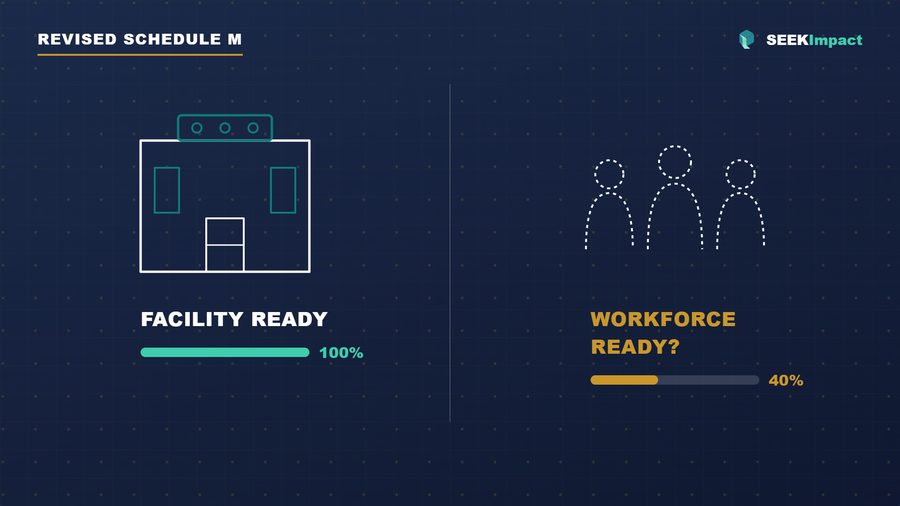
Every pharma manufacturing site can tell you its training completion rate. Almost none can tell you, with confidence, whether that training actually changed what happens on the shop floor.
That gap - between what was trained and what is actually executed - is where deviations start, inspections get difficult, and quality culture quietly erodes.
Here's what the data says:
of 2025 FDA Form 483 findings tie back to training gaps and documentation issues
of manufacturing deviations are linked to human error or execution issues
pharma executives cite workforce capability gaps as a critical operational constraint
Sources: PharmTech, PRP Compliance, IntuitionLabs, industry workforce surveys, 2025.
The Problem: Completion Is Not Capability
Most Learning Management Systems answer one question well: did the employee finish the module? That's a useful record for an audit trail. But it says nothing about whether the operator can consistently execute the procedure correctly under real production conditions - different shifts, different supervisors, months after the training happened.
It helps to separate three terms that get used interchangeably but mean very different things:
The learning activity was delivered and completed.
The individual demonstrated the skill at a point in time, usually in an assessment or observation.
The organization can reliably produce the required performance, at scale, on an ongoing basis, even as people rotate, procedures change, and time passes.
Capability, not completion, is the real indicator of whether training investment is working. A site can be 100% compliant on training records and still fail an inspection on execution - because compliance measures the activity, not the outcome.
The Capability Loop
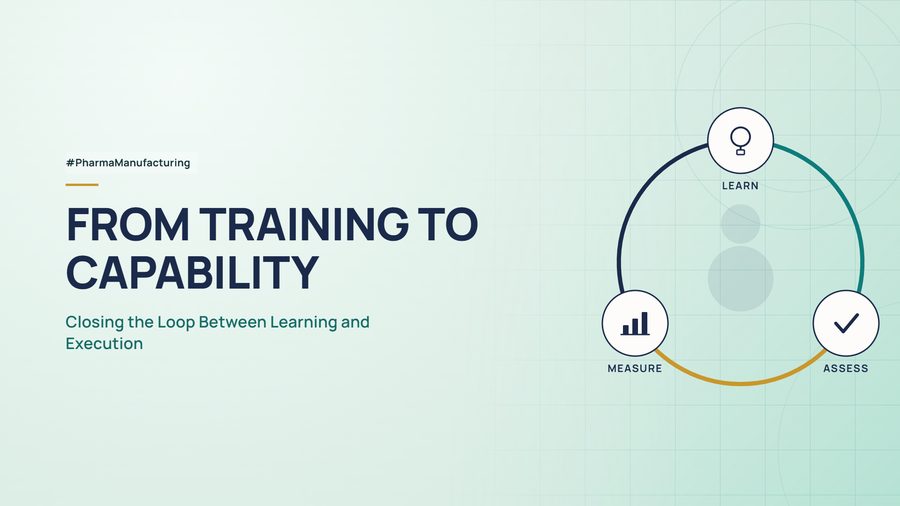
Closing this gap means treating capability as something you manage continuously, not something you certify once and file away.
Assess competency - establish where individuals and teams actually stand today, not where the training record says they should be.
Identify capability gaps - pinpoint the specific tasks, procedures, or roles where performance risk is concentrated.
Deliver targeted learning - close those specific gaps instead of re - running generic, one - size - fits - all training.
Measure capability improvement - verify the gap actually closed, with evidence, not assumption.
Repeat - capability decays over time and with turnover, so the loop runs continuously, not annually.
This is a fundamentally different operating model than the standard train - once, test - once, file - and - forget approach most sites still run.
Why This Matters Right Now
Continuous capability verification is moving from best practice to expectation, across three fronts:
- GMP compliance - inspectors are increasingly probing whether training programs demonstrate ongoing effectiveness, not just completion records.
- Operational excellence - with the majority of deviations traced to human execution, capability gaps are a direct, quantifiable driver of cost and rework.
- Inspection readiness - a site that can produce real - time evidence of workforce capability, not just a training log, walks into an inspection in a fundamentally stronger position.
A Practical Capability Self - Check
Ask these questions about your own site:
- Can you name, today, which specific roles or shifts carry the highest capability risk - or only which courses have the lowest completion rates?
- If an inspector asked you to prove a procedure is being executed consistently six months after training, could you produce that evidence directly?
- When a deviation happens, can you trace it back to a specific, identifiable capability gap - or does it get logged as "human error" and closed?
- Is your training program designed to close the gaps you actually have, or to deliver the curriculum you already built?
If any of these gave you pause, you're not behind - most of the industry is in the same position. The organizations pulling ahead are the ones building the loop deliberately, instead of relying on completion rates as a proxy for readiness.
How SEEKImpact Puts This Into Practice
The Capability Loop above is how we've built SEEKImpact end to end - from data in, to AI - driven capability assessment, to targeted learning delivery, to manager and organization - level insight.