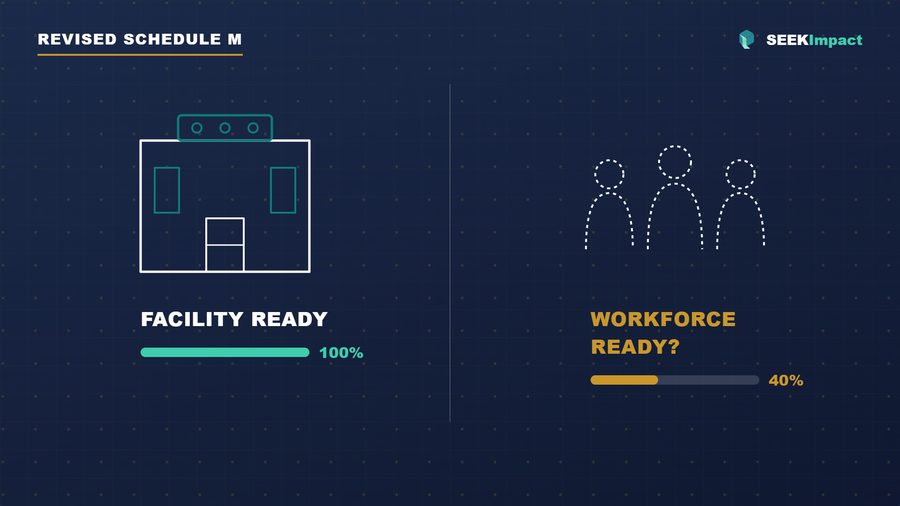
Manufacturers across India have spent the past year and a half investing heavily in facility upgrades to meet Revised Schedule M - new HVAC systems, revalidated cleanrooms, upgraded documentation systems, new equipment qualification.
But one requirement running through the entire regulation gets far less budget, far less attention, and far less airtime in compliance planning: the training and competency of the people actually running that upgraded facility.
Revised Schedule M took effect January 1, 2025, with non - SME manufacturers required to be fully compliant by August 1, 2025, and SME manufacturers by December 31, 2025. CDSCO has already begun immediate, comprehensive inspections at sites that didn't apply for an extension. If your facility is being inspected now, or will be soon, this is the gap worth checking before the inspector does.
What Revised Schedule M Actually Expects - Beyond Training Records
It's easy to read Schedule M's personnel provisions as a documentation requirement: keep attendance sheets, log training completed, file it for the audit. That's not what the regulation is actually asking for.
Revised Schedule M requires personnel to be adequately trained with clearly defined responsibilities - and, more specifically, to possess the qualifications and competencies required to perform their roles in compliance with GMP standards. That's a competency standard, not an attendance standard.
An inspector reviewing your personnel section isn't just checking whether training happened. They're checking whether your people can actually do the job the upgraded facility now requires of them.
Why Infrastructure Compliance Doesn't Guarantee Workforce Capability
Here's the uncomfortable part: a site can pass every facility, equipment, and documentation checkpoint under Revised Schedule M and still be one shift away from a serious deviation - because the infrastructure changed faster than the workforce's ability to operate it.
New cleanroom classifications, new equipment, new SOPs written to match upgraded systems - all of it requires people to unlearn old habits and build new competencies, often on a compressed timeline set by a compliance deadline rather than a learning curve.
“Is the building compliant?”
“Can the people inside it consistently execute what the building now requires?”
Both questions get asked at inspection. Only one usually gets a real answer.
When a Simple Operational Mistake Reveals a Capability Gap - Not a Facility Issue
Here's a scenario that plays out more often than most quality teams would like to admit:
A facility completes its Schedule M upgrade. New equipment is qualified, documentation is airtight, the site passes its internal readiness audit. A few weeks later, a batch deviation occurs - not because of the equipment, but because an operator followed the old procedure on the new equipment.
Training records show the SOP update was “completed.” What they don't show is that the operator was never actually assessed on whether they could perform the revised procedure correctly.
On paper, this looks like an operational error. In practice, it's a capability gap that the training record was never designed to catch - because it measured completion, not demonstrated competency.
This is the exact scenario Revised Schedule M's personnel provisions are trying to prevent, and it's the scenario most training programs are structurally unable to catch until it's already happened.
Training Completion vs. Demonstrated Competency
These two things get treated as interchangeable in most training programs. They aren't.
Training completion means an employee attended a session, watched a video, or read an SOP, and it was logged.
Demonstrated competency means the employee has shown - through observation, assessment, or verified performance - that they can execute the task correctly and consistently, under real conditions, not just in a training room.
Revised Schedule M's language points toward the second standard. Most sites' training records only prove the first.
A Practical Framework for Verifying Workforce Capability Before the Next Inspection
Before your next inspection, walk your critical roles through this:
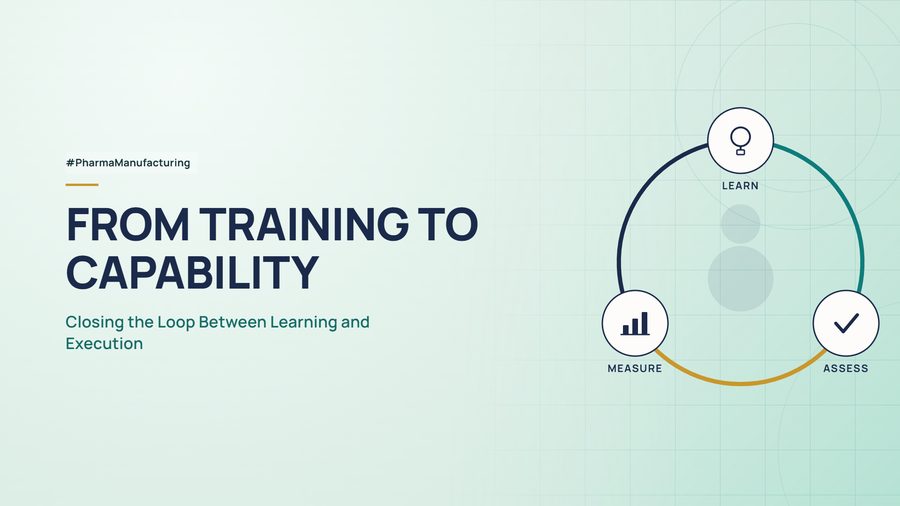
Identify the roles and procedures most affected by your Schedule M upgrades - new equipment, revised SOPs, changed cleanroom behaviour.
Assess actual competency on those specific changes - not general training completion, but direct verification that each person can perform the revised task correctly.
Flag the gaps - where completion is logged but competency hasn't been verified, treat that as an open risk, not a closed record.
Close targeted gaps - deliver focused, task - specific learning to the people and procedures that need it, not a blanket retraining of everyone on everything.
Re - verify and document - capture evidence of demonstrated competency, not just attendance, so it's inspection - ready on its own.
Key Takeaway: Compliance isn't achieved when training is completed.
It's achieved when employees can consistently demonstrate the competency required to perform critical tasks correctly. Revised Schedule M has already changed what your facility looks like. The next question is whether your workforce has caught up to it. See how Revised Schedule M compliance and training software supports that shift from training completion to demonstrated workforce capability.